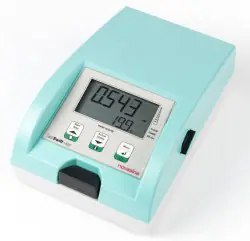
Steam autoclave equipment is frequently found in laboratories, as it is central to operations in modern manufacturing and research. As most labs use their autoclave devices daily, Neutec frequently learns from prospective customers about persistent issues their current devices demonstrate relative to their reliability, maintenance costs, and water/energy consumption. We are here to help you to select the right laboratory autoclave for your specific application and facility; equipment that saves you money today and significantly reduces potential issues in the future.
Neutec Group is proud to offer a broad selection of quality brand steam autoclaves from leading manufacturers such as Tuttnauer, Raypa, and Priorclave. As a North American distributor for leading autoclave companies such as Priorclave, Tuttnauer and Raypa, we are highly qualified to guide users to select the steam autoclave that will meet the specific challenges posed by their daily tasks, facilities, and environments. Our commitment to service excellence does not end with the sale, however. We stand by every autoclave we sell and provide local technical support whenever it is needed.
The Right Autoclave for Your Facility
If you’re replacing an existing steam sterilizer, then this is the ideal moment to ask yourself how well that old autoclave was meeting your needs. Just because you had a 100L sterilizer before doesn’t mean you need to replace it with a new 100L sterilizer. Or, if you relied on a bolt-on steam generator or a house steam sterilizer as your previous unit, that doesn’t mean doing so again is the best choice for you. Your needs may have changed. Together with your Neutec instruments sales specialist as your guide, you can be assured that your choice will meet your current as well as anticipated future needs.
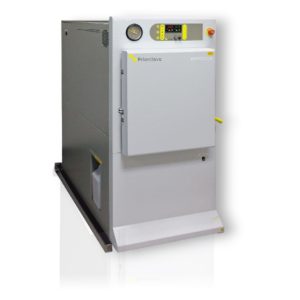
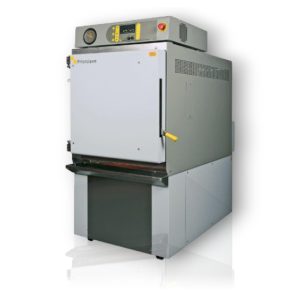
If your laboratory requires a free standing steam autoclave, Priorclave and Tuttnauer models can easily be modified to meet your specific needs, as these offer many optional features and use-specific accessories. Combined with their fully programmable Tactrol Control System, Priorclave’s “off the rack” models will suit most facilities as an ideal autoclave in a microbiology lab. Each free standing autoclave is hand-built, so it may just be the most cost-effective to opt for complete customization.
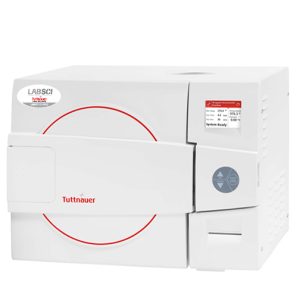
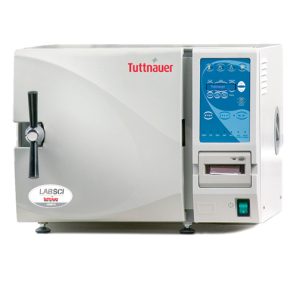
Another option, if your laboratory needs a benchtop steam sterilizer, the Tuttnauer brand may be exactly what you are looking for. This manufacturer’s models are generally immediately available to ship, and therefore can be delivered within a short time frame. It is also an excellent choice for an autoclave in any microbiology lab.
Neutec has assisted manufacturers, life sciences researchers, government agencies, educational institutions, and those in the food and beverage industries outfit their facilities with reliable, full-featured steam sterilizers. We invite you to contact us for a no-obligation consultation, to discuss your facility and typical workloads.
Three Classes of Autoclaves for Laboratory Use
Research-grade autoclaves are generally broken into three broad categories:
- Compact 40 or 60 liter benchtop and tabletop autoclaves for laboratory facilities are ideal for smaller facilities, flexible and shared spaces, etc.
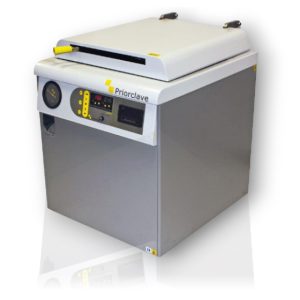
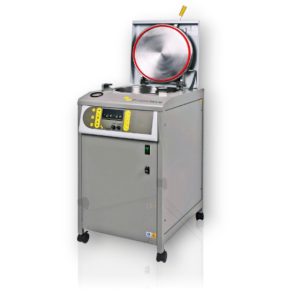
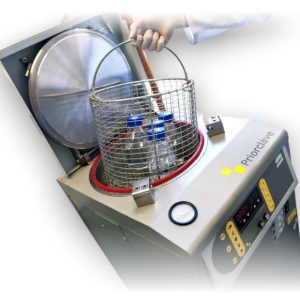
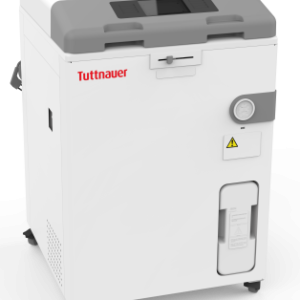
- 60 to 150 liter vertical top-loading autoclaves for laboratory use are ideal to accommodate tall flasks, fermenters, and bioreactors, as well as waste processing.
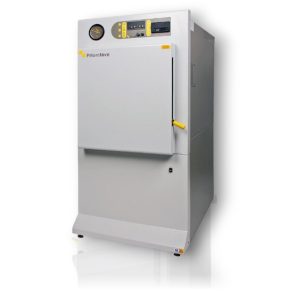
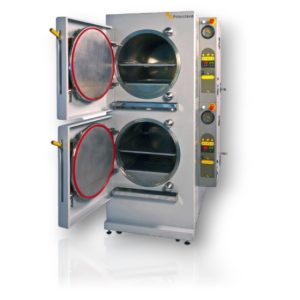
- Larger 100 to 320 liter horizontal front-loading steam sterilizers, which can be configured in many ways, including pass-thru units for clean-room environments
Additionally, all Priorclave units sold in North America are outfitted with the flexible, full-featured Tactrol Control System. This system weds ease-of-use (one-touch start for any cycle) with precision customizable control. With Tactrol, the user can quickly adjust standard settings (process temperature, dwell time, additional free steaming and drying stages, etc.), and also directly control temperature set-points and ramps, monitoring, logging, vacuum pumps, cooling assists, heating elements, cycle repeats, and more. Advanced operators can be given full access, while trainees can be given limited access, or locked into a single validated cycle. Here are some additional advantages to selecting this steam sterilizer: Small labs don’t need to forgo functionality in order to save space, while larger labs can run highly specialized cycles, and techs experienced with a smaller “training” unit can seamlessly shift to a larger production steam sterilizer without retraining for greater ease of use, efficiency and higher productivity.
The Cylindrical Advantage
There are a variety of reasons to choose Priorclave, for its superior cylindrical chamber design. Many steam sterilizer manufacturers favor rectangular autoclave pressure vessels. These are ideal for sterilizers in medical facilities, which are constantly sterilizing multiple trays of rectangular trays loaded with clean surgical supplies, but are a poor fit for the vast majority of non-medical users. In order to maintain their integrity, rectangular pressure chambers have thick, reinforced walls. These walls, however, make the chamber harder to heat and cool and inhibit steam circulation. To compensate for this, medical autoclave manufacturers make a series of design sacrifices throughout the device. The resulting sterilizer has a far higher part-count than a comparable cylindrical-chambered research-grade autoclave, a much more demanding maintenance schedule, and a greater susceptibility to unscheduled downtime. Conventional rectangular autoclaves for laboratory facilities also demand more power, therefore create extremely high electricity bills and water usage. This is why Priorclave relies on efficient cylindrical pressure vessels. Steam sterilizers built around a cylindrical vessel consume less than half as much electricity and at least 87% less water than similar-sized rectangular-vessel models.
To learn more about the select autoclave brands and models that Neutec carries, we invite you to contact us.