Vertical Autoclaves
The food preservation autoclave you need for a medium size production!
Description
To begin, it is important to understand that the terms Autoclave and Sterilizer are interchangeable. Autoclave devices are primarily used in laboratories, while sterilizers are more commonly used for medical and pharmaceutical applications. When used by researchers studying food production, a food preservation autoclave machine uses steam to kill harmful bacteria, viruses, fungi, and spores that may be present on subject matter that is placed inside the pressure vessel. The subject matter is then heated to an appropriate sterilization temperature for a given amount of time. During this period, moisture in the steam will efficiently transfer heat to the subject matter to effectively destroy the protein structure of any bacteria and/or spores that may be present.
There are three factors that must be present to ensure a successful autoclave food preservation process. These are time, temperature and steam quality. Meeting these requirements involves three phases in the food autoclave process:
- Conditioning Phase: Air inhibits the food autoclave process and must be removed from the chamber during the first phase of the sterilization cycle. This cycle is known as conditioning. In dynamic air removal-type steam sterilizers, the air can be removed from the chamber using a vacuum system. It can also be removed without a vacuum system using a series of steam flushes and pressure pulses. Gravity-type sterilizers use steam to displace the air in the chamber and force the air down the sterilizer drain.
- Exposure Phase: Next, the food autoclave drain will close, to allow steam to be continuously admitted into the chamber, thereby rapidly increasing the pressure and temperature inside to a predetermined level. The cycle then enters the exposure phase, where subject items are held at the sterilization temperature for a fixed amount of time required to sterilize them.
- Exhaust Phase: During the final phase of the cycle, exhaust, the sterilizer drain is opened and steam is allowed to escape, thereby depressurizing the vessel to allow the items in the load/batch to dry.
NOTE: The steam quality is vital to a successful food preservation autoclave process. The steam used for sterilization should be composed of 97% steam (vapor) and 3% moisture (liquid water). This ratio is recommended for the most efficient heat transfer. When the steam moisture content is less than 3%, the steam is described as superheated (or dry). Superheated steam is too dry for efficient heat transfer and is ineffective for successful autoclave food preservation processes.
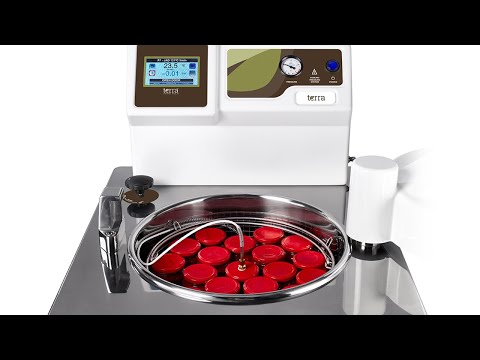
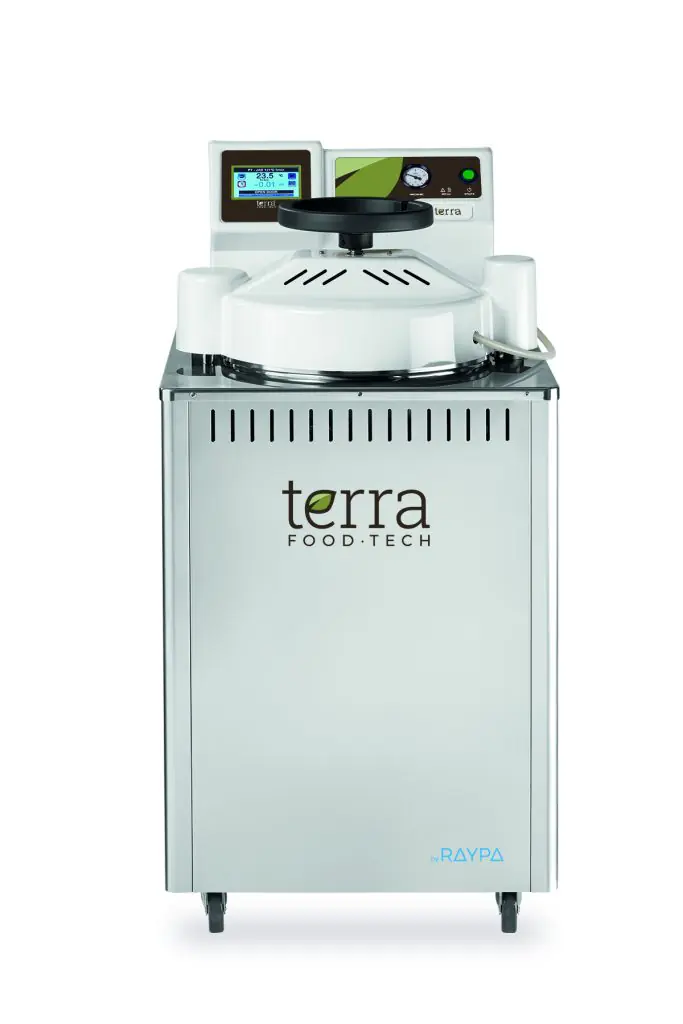
Neutec recommends the Vertical Autoclave by Raypa, an optimal food preservation autoclave machine. Details of this product follow:
Retorts with counter pressure
Both pasteurization and sterilization are techniques of autoclave food preservation by applying heat. Their aim is the destruction of microorganisms and their spores. The difference between the two techniques lies in the time and temperature of the heating process.
Sterilization
Sterilization is performed on a variety of foods, such as meat, fish, vegetables, and fruit. It is performed by placing food in a container and subjecting it to temperatures above 100ºC, usually 121ºC, during a certain period of time. After this process, all microorganisms and spores are inactivated.
Pasteurization
Pasteurization involves heating food at temperatures below 100ºC for a brief period of time. This method is used in many products, especially in milk and its derivatives, flavored juices, beers, because the low temperatures respect and preserve the aromas and other organoleptic characteristics. These food products have a shorter shelf life, because although viable microorganisms are drastically reduced, some remain viable.
| Model | CFS-28V | CFS-50V | CFS-75V | CFS-110V | CFS-150V |
| Capacity | 33L | 55L | 79L | 115L | 175L |
| Chamber Dimensions | 300 x 420 mm | 300 x 690 mm | 400 x 580 mm | 400 x 830 mm | 500 x 760 mm |
| Chamber Volume total/usable | 33/30L | 55/48L | 79/73L | 115/104L | 175/150L |
| External Dimensions LxDxH | 505 x 580 x 1110 mm | 505 x 580x 1290 mm | 610 x 700 x 1185 mm | 610 x 700 x 1435 mm | 750 x 820 x 1400 mm |
| Weight | 90 kg | 110 kg | 140 kg | 180 kg | 265 kg |
| Power | 3200 W | 3200 W | 6000 W | 6000 W | 9000 W |
| Frequency | 50/60 Hz | 50/60 Hz | 50/60 Hz | 50/60 Hz | 50/60 Hz |
| Electrical Voltage * | 230 (1P+N+E) V | 230 (1P+N+E) V | 400 (3P+N+E) V | 400 (3P+N+E) V | 400 (3P+N+E) V |
| Amperage | 14.5 A | 14.5 A | 9 A | 9 A | 14 A |


Safety Features
- Protection against overpressure in the chamber
- Safety thermostat
- Open door detection
- Positive pressure detection in the sterilization chamber
- Water inlet pressure sensor
- Water level detector
- Cover thermal protection of the lid
- Protective chassis for the sterilization chamber
Specifications
| Temperature | 50-130ºC |
| Sterilization Time | 1-250 minutes |
| Max Pressure | 2.2 bar |
| Programmable Counterpression | up to 2.2 bar, depending on selected temperature |
| Double System Temperature Control | PT100 Flexible probe and Fixed probe in the sterilization chamber |
| Sterilization Control System | by programming the F0 value and maximum temperature |
| Pasteurization Control System | by programming the P0 value and maximum temperature |
| Chamber and Lid Material | AISI 316L stainless steel |
| External Case Material | AISI 304 stainless steel |
| Gasket | Silicone rubber |
| Connection PC | Ethernet port |
| USB | Automatic export of results to USB key |
| Storing of Test Cycles | 100 sterilizations cycles |
| Number of Programs | 50 programs |
| Programmable Autostart | Date and time |
| Automatic Water Feeding | Minimum water inlet pressure 3.5 bar |
| Screen | 5″ color touch screen |
| Cooling System | Direct shower in sterilization chamber |
| Casters | 4 wheels, 2 of them with brake |
Download Center
View Video