
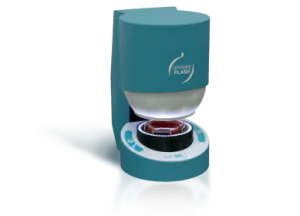
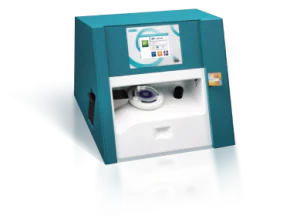
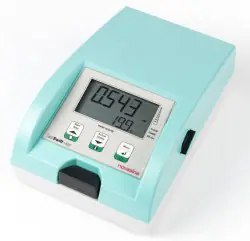
Water activity testing, gauged by using a water activity meter, is most often used to determine the shelf life of a food product. It is important to gauge the amount of water in a food as it is known that water activity above 0.95 a w will provide sufficient moisture to support the growth of bacteria, yeast, and mold. Because it predicts stability relative to microbial growth, their rates of deteriorative reaction, and physical properties, water activity is considered to be an important property in the field of microbiology. In fact, regulatory agencies such as the Association of Official Analytical Chemists (AOAC), International Organization for Standardization (ISO), American Society for Testing and Materials, (ASTM) United States Pharmacopeia (USP) and a host of American, Canadian and International governments, have incorporated water activity standards into their safety regulations. If the water activity of food is controlled to 0.85 a w or less in a finished product, it is considered regulation-compliant.
Water activity testing is performed using a device known as a water activity meter, calibrated to exacting standards. The two primary methodologies employed for water activity testing are the dew-point chilled mirror method, or the capacitance method for materials that contain volatile compounds. Water activity testing is measured using meters that employ these two methodologies. Water activity in foods is controlled by removing water (by drying or freezing), by adding salt (curing), or by adding sugar (as in jams and jellies). Water activity is a sound predictor of food safety as well as to help determine how long a shelf life for an individual food product. Below are the standards set by a wide range of national and international organizations and governments:
Water Activity Standard Methods
| Method | Publication Date | Industry | Requirements |
| AOAC 978.18 | 1990 | Food | Saturated salt solutions for standards, electrolyte polymer and dew point sensors acceptable |
| ISO18787 | 2017 | General | Temp control +/- 1C, resolution 0.0001aw, difference for 3 measurements or 1 minute, not sensitive to volatiles, saturated salt standards |
| ASTM D8196-18 | 2018 | Cannabis | Temp control +/- 0.1C, resolution 0.001aw, accuracy +/- 0.005 aw, range 0.40 to 0.80 aw |
| Compendium of Micro Methods Chp 68 | 2015 | General | Requires an accuracy of +/- 0.003aw |
| USP <922> | 2021 | Pharma | Does not specify an accuracy requirement, but does give recommendations for application |
| MFLP_63 Canada | 2006 | Food | Procedure for using Novasina to measure water activity |
Water Activity Testing in Government Regulations
| Agency | Application | Industry | Testing Requirements |
| FDA | In HARPC, serves as a monitoring tool for water activity as a preventative control for microbial growth | Food | Water activity test results must be verified, confirming that all equipment is operated, maintained, and calibrated properly |
| USDA | Monitoring tool for Generic HACCP plans | Meat | Water activity testing should be done according to accepted standard methods |
| ASTM D8197-18 | Monitoring tool for preventing microbial growth | Cannabis | Water activity testing should be done according to ASTM D8196-18 |
| USP 1112 and 51 | Justification for reduced microbial testing and to maintain testing and to maintain drug safety | Pharma | Water activity testing should be done according to Compendium of Microbial Methods, Chapter 64 or other accepted standard method |
| ICH | Part of Decision Tree #6 and #8 to justify reduced microbial testing | Pharma | Water activity testing should be done according to Compendium of Microbial Methods, Chapter 64 or other accepted standard method |
| ISO29621 | Water activity testing can identify products with low microbiologically risk | Cosmetics | Water activity testing should be done according to ISO18787 |
| Canadian FIA | Water activity determines potentially hazardous food | Food | Water activity testing should be done according to accepted methods |
| UN Food and Ag Organization | Water activity can be used for food preservation | Food | Water activity testing should be done according to accepted methods |

June 22, 2021 – Scientist Live
Dr. Brady Carter discusses the new standard for water activity measurement
Water activity has been broadly used in the pharmaceutical industry since the publication in 2006 of USP <1112>, an informational chapter on the application of water activity in pharma. Although <1112> provided guidance for the utilization of water activity, it was not an official method. Now USP has developed USP <922> Water Activity as an official method that will hopefully further facilitate its implementation as an integral part of a pharmaceutical quality program.

There can be an abundance of confusion with water activity instruments concerning test time. Some instruments claim a 5-minute test time while others offer fast or quick modes. The truth is that water activity test time is determined by the sample and not the instrument. Since water activity is an equilibrium measurement, a reading is not complete until vapor equilibrium has been achieved and this process cannot be sped up by an instrument (1). So, any claim to a specific test time is illogical and would only be true for select samples. The reality is that most types of samples require a minimum of 5 minutes or more to reach true equilibrium and test times that are faster than that are either using a prediction or the system uses end-of-test settings that are not stringent enough to achieve true vapor equilibrium.
January 4, 2022 – Scientist Live
Dr. Brady Carter on modelling shelf life with water activity
The shelf life of a product is defined as the practical time that it remains desirable to consumers. It dictates the radius of distribution for the product, how it must be stored and its best by date. Failure to match this expected shelf life can result in customer complaints, product recalls and tarnished reputation. Consequently, correctly determining the optimal production process and handling that maximizes the shelf life and then monitoring to make sure those conditions are met is the difference between profitability and lost revenue.